


 How to Operate a Mini Excavator: Step-by-Step Beginner Guide
Entering a mini excavator’s cab for the first time can be daunting. You confront a complex panel of gauges, robust joysticks, and safety levers controlling significant hydraulic force. Yet, mastering heavy equipment operation necessitates patience, respect for the machine, and a systematic approach to learning the controls.
Reliable equipment demands skilled operators. When you know how to operate a mini excavator correctly, you maximize the machine’s durability, prevent costly downtime, and ensure excellent results on the job site. This mini excavator beginner guide breaks down the entire process from the moment you approach the machine to your first successful trench.
You will also learn how to carry out vital pre-operations, including the application of strict safety measures. We will take you through the basic controls of a mini excavator, how to operate it, and basic digging rules. The process is simple, and the information is purely factual. Through this process, you will gain the confidence needed to operate this equipment.
Preparing for Operation
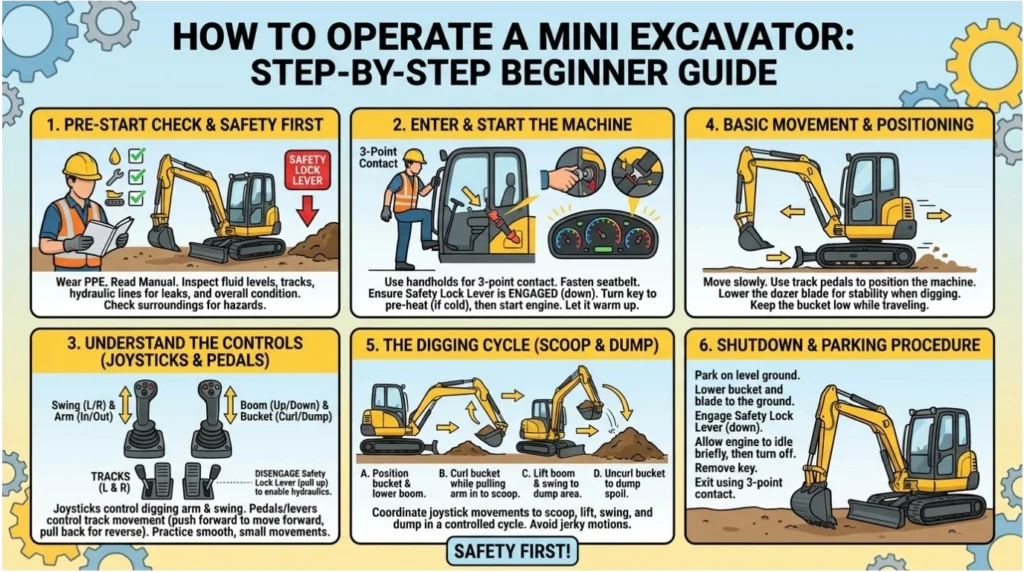
Operating heavy equipment begins before ignition. A thorough pre-operation inspection guarantees functionality and protects your investment from preventable harm.
To start, check the excavator’s exterior, particularly the undercarriage, including track tension and the condition of the sprocket, which can be clogged or worn out. Additionally, check all hydraulic lines and cylinders, as leaks can cost thousands of dollars in repairs and cause environmental damage.
Check the lights, including the taillights, brake lights, and turn signal lights, which are particularly important in the early morning or after sunset. Check the mirrors, which are equally important because they provide a clear view of what is behind the machine, helping you avoid accidents.
Next, check your vital fluids. Check that the engine oil, hydraulic fluids, and coolant levels are at the recommended levels. Make sure the air filter is clean and the battery terminals are firmly connected. If you notice any problems, make sure to fix them before you start to use the equipment. To get a better understanding of this equipment and its place in your fleet, read our Complete Guide to Mini Excavators: Types, Uses, Pricing & Buying Tips (2026).
Lastly, get to know the operator station. Before you use the equipment, sit on the seat and become familiar with its parts. Locate the ignition, the throttle dial, the safety lockout lever, the drive levers, and the two joysticks. Make sure that you can comfortably reach all the controls without straining.
Essential Safety Procedures
Safety constitutes the foundation on which all professional construction operations are built. Operating the compact excavator poses considerable hazards, including tipping over, striking utilities, and pinch-point injuries. Following strict security guidelines ensures your, your crew’s, and the equipment’s safety.
Wear the proper Personal Protective Equipment (PPE): a hard hat, high-visibility clothing, steel-toed footwear, safety glasses, and hearing protection. When entering the cab, use three points of contact with the handles and tracks. Never use the joysticks to pull yourself into the cab. Fasten your seatbelt immediately after sitting down.
The job site itself is also an important factor to be considered. It is important to note that all underground utilities need to be located before any digging is done. You need to call your local underground utility locating service to mark any gas, water, and electric lines. You also need to observe the terrain, noting any steep slopes, loose ground, and overhead hazards such as power lines or tree branches. If you need to cross a slope, always dig straight up and down the slope, never sideways, to prevent a rollover.
Communication is what keeps the site secure. Hand signals must be established with your ground crew prior to starting the machine. If visual contact with your spotter is lost, stop the machine immediately. No one should be within the excavator’s swing radius when the engine is running.
 Step-by-Step Operation Guide
Now, once you’ve cleared the area, you are ready to power the machine. Start the engine, but let it idle for a while. This will ensure the hydraulic fluid is at the optimal temperature for smooth operation.
To turn on the hydraulic system, lower the safety lockout lever on the left armrest. Without lowering the lever, the joystick will not function, nor will the track move. The engine should be set to a low speed when you are first learning how to use the machine. The slower the machine moves, the more time you will have to respond to the situation.
Most contemporary devices use a standard joystick control pattern defined by ISO. The left joystick operates the upper house swing and the stick, which is the portion of the arm to which the bucket is attached. Moving the left joystick left or right will rotate the entire cab. Moving the left joystick forward will extend the stick away from you, and moving it back will crowd the stick towards you.
The right joystick operates the boom and the bucket. Moving the right joystick back raises the boom, and moving it forward lowers it. Moving the joystick left will cause the bucket to fold inward to scoop up dirt, and moving it right will cause the bucket to open up to dump dirt.
To operate the mini excavator models, use the two tall levers located at the center of the floor in front of you. When you move these two levers forward, the excavator will move forward. When you move the two levers backward, the excavator will move backward. To turn the excavator, move one lever farther forward than the other. For instance, if you move the left-side lever forward while keeping the right-side lever neutral, the excavator will turn to the right. You need to check the backfill blade to determine the direction of “forward.”
Basic Digging Techniques
For digging, use smooth, controlled movements—never abrupt or harsh. Digging quality depends on reliability and exactness. Always start with. For digging, use smooth, controlled movements—never abrupt or harshly. This will give the machine great stability and enable it to have a great breakout force. Position the excavator so you are digging over the front of the tracks, not the sides. Digging over the side will give you much less stability and could cause the machine to tip over.
Extend the boom and stick to position the bucket teeth at your starting location. Tilt the bucket slightly inward to engage the teeth with the earth. Pull the left joystick backward to move the stick toward you and adjust the boom height with the right joystick as needed.
As your bucket fills, fully close it. Raise the boom to clear your trench, using the left joystick to rotate toward your spoil pile or dump truck. Open the bucket to dump dirt, return the cab to your trench, and repeat. Smooth, continuous motions, rather than stopping and going between each action.
Expanding Your Capabilities
Once you become comfortable with the basic controls, you can expand the machine’s capabilities. Mini excavators are extremely multifunctional tool carriers. You can use different attachments to accomplish different tasks.
Hydraulic tool connections require an understanding of the auxiliary hydraulic flows. The majority of excavators have an auxiliary hydraulic line that runs down the boom. When a hydraulic thumb, concrete breaker, or auger is attached, these lines power the tool. The attachments are controlled with a thumb-roller switch on the main joysticks or a foot pedal.
However, it is always important to ensure that the machine you are using has enough hydraulic flow for the attachment you wish to use. Using a high-demand tool on a machine with low hydraulic flow can cause the machine to perform poorly and may lead to premature component wear. To get the full scope of the various tools and their uses in the real world, you can check out the article on Mini Excavator Attachments & Uses: Complete Guide for All Applications.
Conclusion
It is essential to learn to operate a mini excavator effectively, which requires practice, patience, and safety. By becoming more familiar with the machine’s basic components and learning to follow the ISO control pattern, you can establish a solid foundation for operating heavy equipment.
It is critical to closely monitor your daily pre-operation checks to ensure the performance and dependability of your equipment. A reliable machine can effectively meet your needs and help you achieve profitable operations for a long time. Never sacrifice safety, even for small tasks.
Take time to practice driving and digging skills in an open area before getting into complex jobs. As you become more confident, you will realize the amazing efficiency and power these machines can deliver. This guide is meant to serve as a reference for you, and you should continue learning and improving your skills to get the most out of your investment.