

 How to Choose the Best Mini Excavator: Pricing & Tips
Expanding your heavy equipment fleet is a capital and planning-intensive process. By acquiring mini excavators, you are investing in your business’s future productivity and profitability. The right equipment will move through tight job sites with ease, deliver the necessary breakout force, and provide years of reliable service. The wrong equipment, however, will bleed your budget dry through excessive fuel consumption, breakdowns, and lackluster performance.
To ensure you get the most out of your investment, start by defining clear operational objectives. With this foundation, you can make factual comparisons of equipment, sizes, and manufacturers. The following guide will help you make the right decision in acquiring mini excavator equipment that fits your needs.
We will walk you through evaluating your job site needs and determining the best weight class for your project. We will show you the real cost of compact excavators, including how to compare new and used prices and calculate the total cost of ownership. We will also walk you through how to evaluate the best mini excavator brands and dealership networks. If you would like to get a broader overview of how mini excavators might fit into your fleet, check out our Complete Guide to Mini Excavators: Types, Uses, Pricing & Buying Tips (2026).
Assessing Your Equipment Needs
Before you even look at individual price tags, you have to determine precisely what you want to accomplish with your machine. Making assumptions can cause costly purchasing errors. It’s imperative that you determine your standard work projects and physical site limitations.
Start by analyzing your standard work projects. Do you dig shallow trenches for residential plumbing projects, or do you dig deep foundation holes for commercial projects? Your standard work projects determine your standard machine requirements for horsepower and hydraulic flow. If you intend to run large equipment like concrete breakers or brush cutters, you’ll want a machine with high auxiliary hydraulics.
Then, consider your physical site limitations. Urban projects or residential backyards may have narrow access, low overhead, and weight restrictions. If you work through standard fence gates, choose a compact machine with a retracting undercarriage. Measure your tightest access points to ensure you can get your machine to the work site. also have to consider your transportation logistics. For instance, moving a heavy machine requires a specialized trailer and towing vehicle. You also have to consider whether upgrading to a heavier excavator requires upgrading your heavy-duty truck and obtaining a commercial driver’s license for your operators.
Selecting the Right Class and Specifications
Once you understand your site’s needs, match them to machine classes. Compact excavators are divided into operating weight categories. Choosing the right class ensures you get enough digging depth and lifting capacity, without overspending for unnecessary power.ro excavators, weighing less than one ton, offer unparalleled access to tight spaces. They work well for indoor demolition and small landscaping projects. Unfortunately, they lack reach and breakout force for large earthmoving projects. The range of compact excavators weighing between one and three tons is probably the best choice for general contractors. These offer superior trenching power and can be towed behind a standard heavy-duty pickup truck.
Heavy-duty compact excavators weigh between three and six tons. These machines offer strong lifting ability and maximum digging depth. They handle tough commercial jobs and large attachments easily. However, they are larger and have higher transportation costs. Refer to ‘What Is a Mini Excavator? Types, Sizes & Key Features Explained’ for more on categories and features. Also have to decide whether to opt for a standard tail-swing excavator or a zero-tail-swing excavator, also known as a ZTS excavator. Standard excavators give a bit more stability when lifting and a more spacious cab for operators. However, zero-tail-swing excavators keep the excavator housing fully within the track width, allowing your operators to safely dig close to structures without hitting them during rotation.
New vs. Used Mini Excavators
One of the most important financial decisions you are likely to make is whether to buy a new or a second-hand machine. Each of these options has its advantages and disadvantages depending on your financial situation and risk appetite.
Buying a brand-new machine offers the greatest peace of mind. This is because a brand-new machine comes with the latest engine technology, improved fuel efficiency, and the latest hydraulic systems. Moreover, a brand-new machine comes with a manufacturer’s warranty in case of premature failure of its components. Most importantly, a brand-new machine has zero hours on the undercarriage and the engine, ensuring it can operate without stopping for years. However, the downside of a brand-new machine is that it comes with a higher purchase price and immediately depreciates the moment it leaves the dealership.
When inspecting a used excavator, ensure the undercarriage is in good condition. Worn-out sprockets, cut rubber tracks, and leaking travel motors are clear signs that the excavator was poorly maintained. Check the hydraulic cylinders for any signs of scoring or leaking. Check for unusual knocking sounds when the engine is started, and ensure the boom functions well even under heavy load.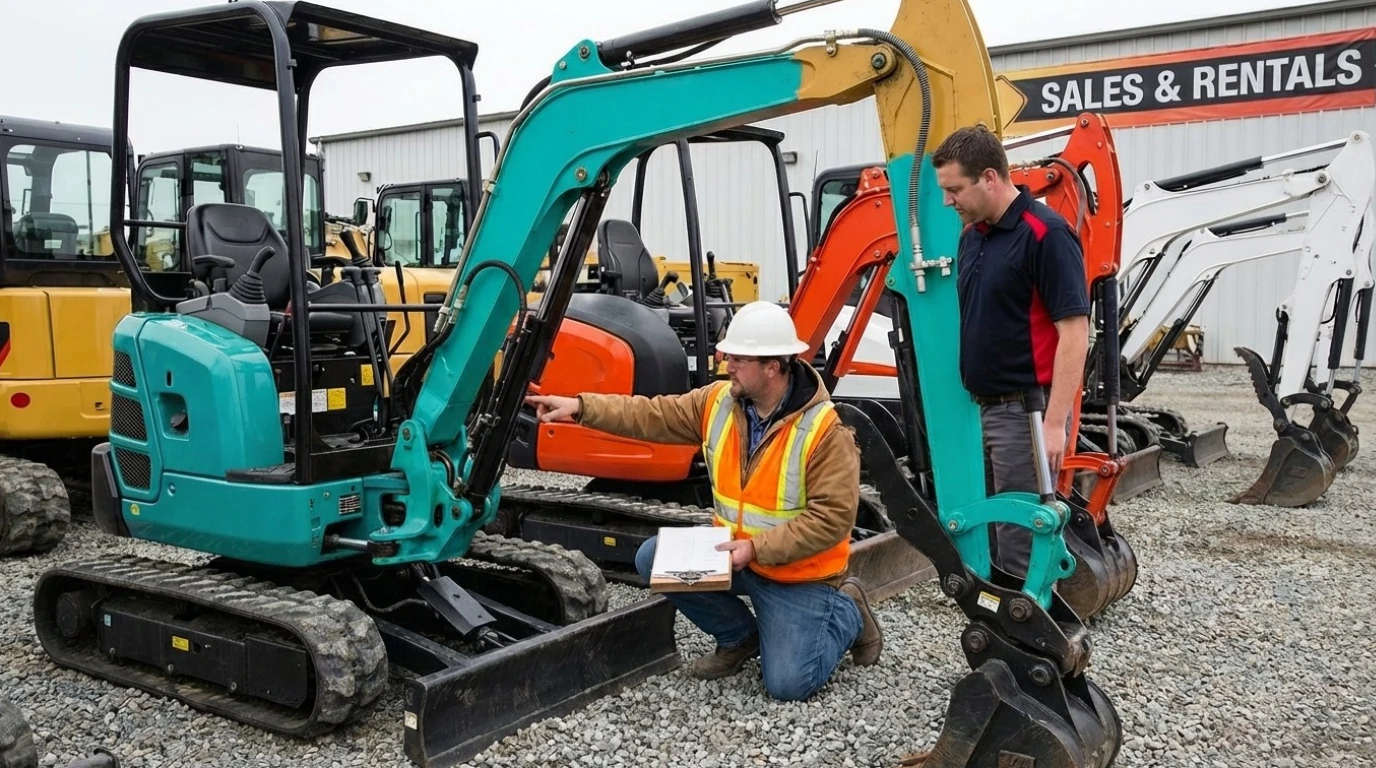
Navigating Pricing and Total Cost of Ownership
It’s not possible to understand the pricing of a mini excavator without considering more than just the price tag in a dealer’s yard. While the initial purchase cost is an important consideration, the total cost of ownership (TCO) helps you understand the actual impact on your business.
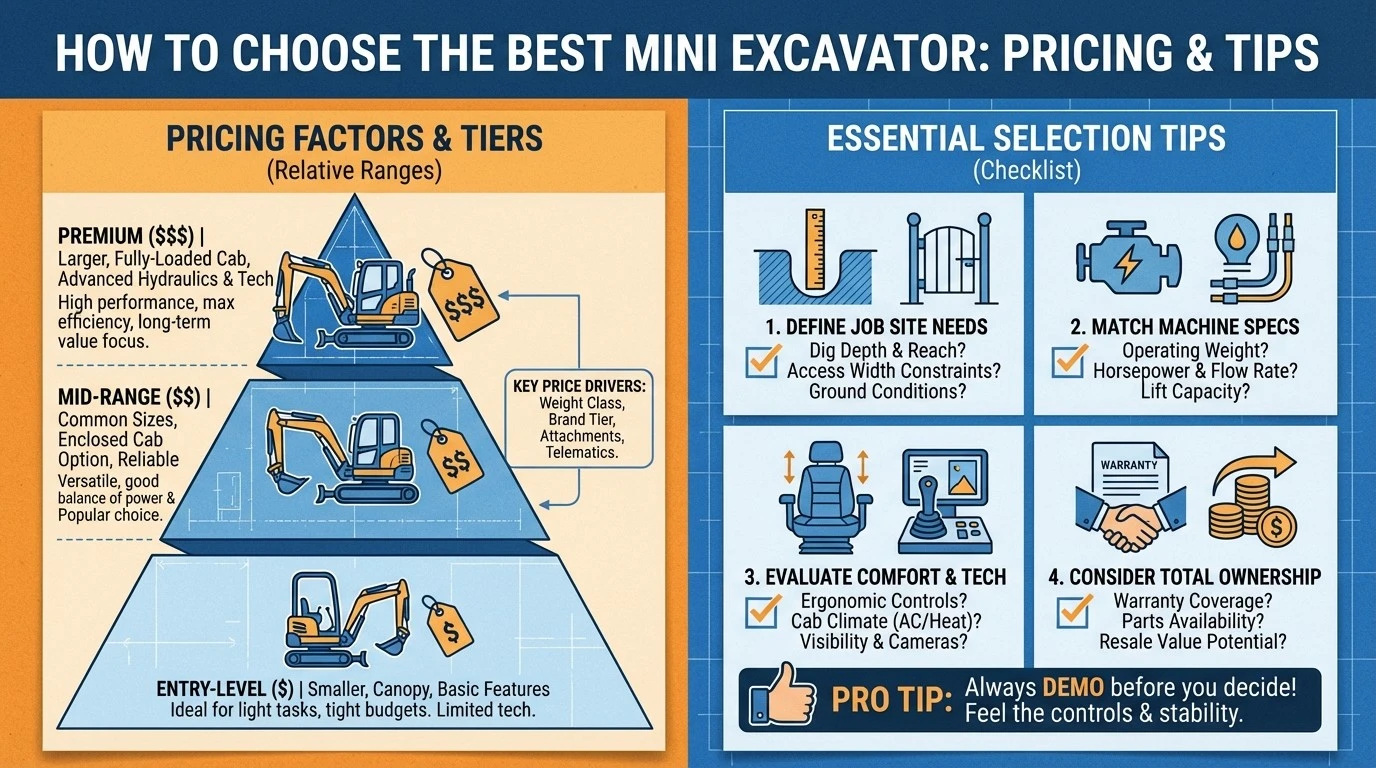
The average purchase price for a mini excavator can vary significantly depending on its weight class and feature set. In 2026, a brand-new one-ton micro-class excavator can start at a purchase price between $25,000 and $30,000. A three-ton class excavator can range between $45,000 and $60,000. A six-ton class excavator with premium features such as an enclosed cab, climate control, and high-end hydraulics can cost over $85,000.
However, to determine the actual cost of the compact excavator, you need to consider the daily operational costs. First, determine the annual fuel costs based on the manufacturer’s stated fuel burn rate. Then, you need to determine the insurance premiums, which are directly proportional to the machine’s replacement value. You should also consider the costs of routine operational materials, such as the bucket teeth, the machine’s rubber tracks, and hydraulic oil.
Maintenance costs are a major factor in the compact excavator’s total cost of ownership. Proper maintenance helps you avoid high repair costs while preserving the machine’s resale value. Failure to maintain the machine results in costly repairs and lost income from downtime. To maintain the machine and determine a routine service schedule, you should check out the Mini Excavator Maintenance Guide: Schedule, Tips & Common Problems.
Evaluating Top Brands and Dealership Support
The brand name on the boom is important. There are several leading brands in this industry, all of which have a reputation for building high-quality equipment. When searching for the best mini excavator, it is crucial to consider not only the manufacturer’s reputation but also the support capabilities of your local dealership.
The leading brands in the mini excavator industry have invested significantly in research and development. They only use high-grade structural steel, diesel engines, and hydraulics. By purchasing equipment from leading manufacturers, you can be assured that it will withstand the demands of your construction site. These brands have significantly higher resale value if you ever need to upgrade your equipment.
But even the best equipment needs parts and service. Your relationship with the dealership is as important as the hardware. Before buying, check if the dealership stocks standard replacement parts. Avoid places where you might wait days for needed parts to be shipped. Search the dealership’s service department. Find out about their warranty claim policy. Also, find out if they have mobile field technicians. If your equipment breaks down on the jobsite, you need a dealership with a service department that can dispatch a mechanic quickly. Total support beyond the initial sale is what will make an equipment dealership valuable.
Conclusion
Choosing a compact excavator is a highly strategic decision that directly affects your bottom line. By analyzing your typical requirements and logistics, you can avoid the trap of buying too many or too few machines. The right weight class and tail-swing design ensure your operators can work safely and efficiently in their typical environments.
Managing the financial side of things demands a long-term approach. Whether you’re buying new or used, calculating the cost of ownership helps you protect your cash flow. Keep in mind that fuel consumption, insurance, and maintenance costs are major contributors to the cost of ownership.
Lastly, reliability and support are a must. Look for established mini excavator manufacturers and local dealerships with a reputation for standing behind their products. An exceptional piece of equipment, backed by a top-notch support team, means maximum uptime and profitability. Take your time researching your options, asking questions, and seeking out quality equipment that will last for years to come.