


 🚜 Smart Mini Excavators & AI Technology in 2026
Why Intelligent Compact Excavators Are Transforming the Construction Industry
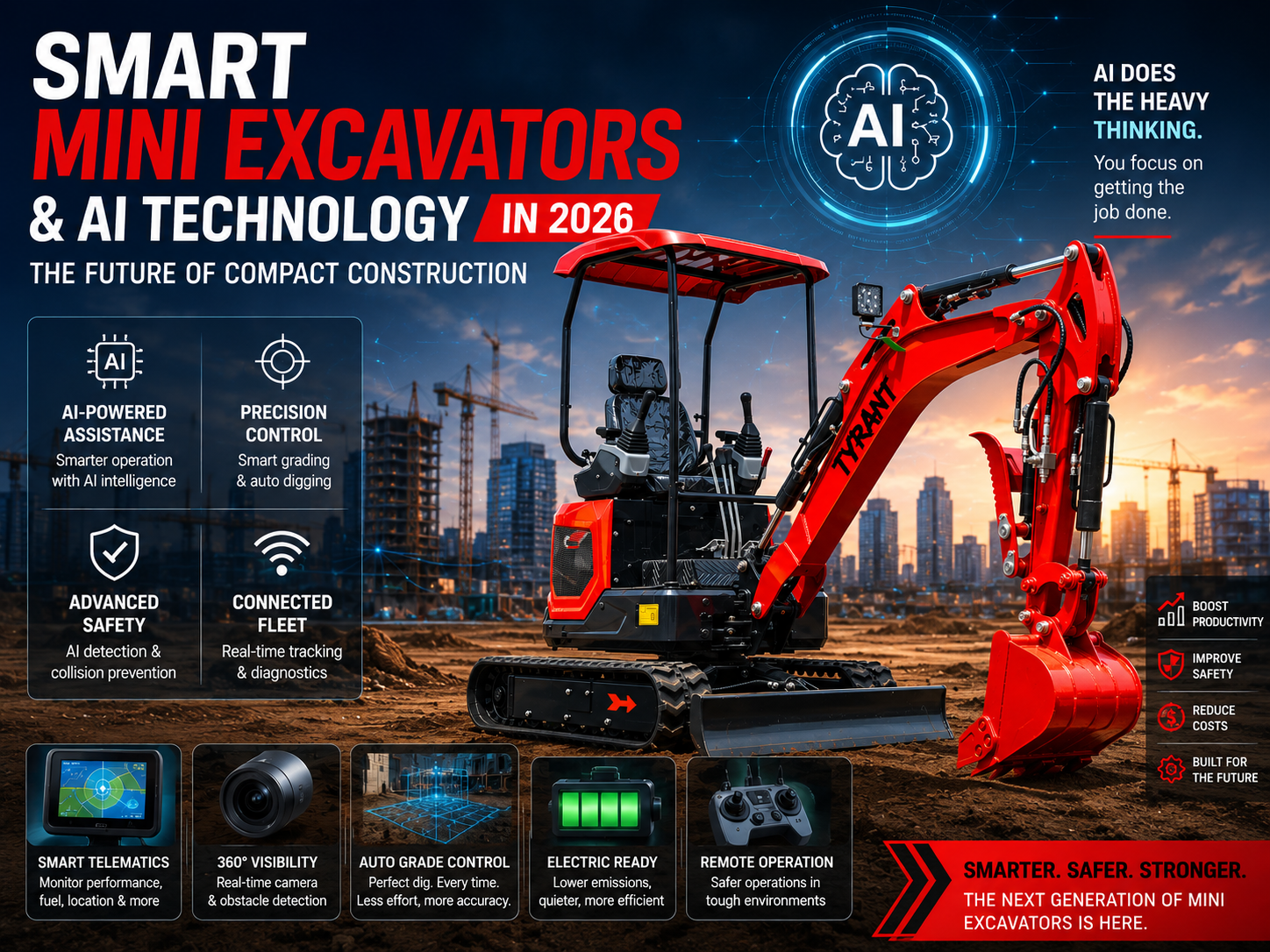
The construction equipment industry is entering a new era in 2026. Mini excavators are no longer viewed as simple compact digging machines designed only for trenching or landscaping. Today’s modern excavators are becoming intelligent, connected, highly efficient construction systems powered by artificial intelligence, smart automation, telematics, advanced hydraulic technology, and semi-autonomous operation.
Across the world, contractors, landscapers, rental companies, developers, and infrastructure businesses are searching for equipment that can improve productivity while lowering labor costs and increasing safety. Because of these demands, manufacturers are racing to develop smarter compact equipment capable of performing more work with less operator fatigue and greater efficiency.
The mini excavator market has experienced explosive growth because compact machines can access tight spaces that larger excavators cannot reach. Urban construction, residential projects, indoor demolition, orchard farming, landscaping, utility trenching, and small-scale infrastructure development are all driving demand for compact excavation equipment.
In 2026, the biggest technology trends shaping the future of mini excavators include:
- AI-powered operating systems
- Smart grade control
- Autonomous assistance
- Connected telematics platforms
- Intelligent hydraulic systems
- Electric compact excavators
- Remote-controlled operation
- Advanced safety systems
- Smart fleet management
- Real-time diagnostics and maintenance monitoring
Modern mini excavators are becoming smarter, safer, and more productive than ever before.
🤖 The Rise of AI-Powered Mini Excavators
Artificial intelligence is now becoming one of the most important innovations in construction equipment.
For decades, excavators depended entirely on operator skill. Digging precision, grading accuracy, trench alignment, and attachment control all relied heavily on experience. In 2026, AI is beginning to change that reality.
Manufacturers are integrating AI systems directly into mini excavators to help operators perform tasks faster and more accurately. These systems use sensors, onboard computing, cameras, radar, and hydraulic monitoring to assist with machine operation.
AI-powered excavators can now:
- Automatically optimize hydraulic flow
- Assist with digging angles
- Reduce fuel consumption
- Detect obstacles
- Improve grading precision
- Monitor operator behavior
- Adjust machine performance in real time
One of the biggest announcements in 2026 came from Bobcat, which introduced its AI-powered “Jobsite Companion” system. This technology allows operators to interact with excavators using voice commands while AI automates machine functions and attachment settings. The system reportedly manages more than 50 automated machine functions without relying on cloud connectivity.
This represents a major shift for the industry because operators no longer need to manually control every aspect of machine performance. AI assistance helps reduce operator fatigue while improving consistency and efficiency.
DEVELON also introduced next-generation compact excavators featuring AI-powered safety systems, intelligent emergency stop technology, and electronically controlled hydraulic systems. These machines are designed to make excavators easier to operate for both experienced professionals and first-time operators.
As labor shortages continue affecting the construction industry worldwide, AI-powered excavators are helping businesses reduce training time while improving productivity.
🛰️ Smart Grade Control & Precision Digging
One of the most important innovations in compact excavators is intelligent machine control and smart grading technology.
Traditionally, grading and trenching required highly skilled operators because even small mistakes could lead to uneven surfaces, incorrect trench depth, or costly rework. Smart grade control systems now use sensors, GPS technology, and machine learning to improve digging precision automatically.
Komatsu introduced its IMC 3.0 intelligent machine control system in compact excavators, adding features such as:
- 3D machine control
- Semi-autonomous trenching
- Boundary restriction systems
- Swing-to-line automation
- Payload monitoring
- Auto grading assistance
These technologies help operators maintain precise digging depth and trench alignment while reducing human error.
Smart grading technology is especially valuable in:
- Residential construction
- Utility trenching
- Landscaping projects
- Urban development
- Road construction
- Drainage installation
By automating certain digging functions, contractors can complete projects faster while using fewer resources.
Precision excavation also reduces material waste and fuel consumption, which lowers operating costs and improves environmental efficiency.
📡 Connected Telematics & Smart Fleet Management
Modern construction equipment is rapidly becoming connected through telematics systems.
Telematics allows fleet owners and contractors to remotely monitor excavator performance in real time using smartphone apps, cloud dashboards, and GPS systems.
Kobelco expanded its KOMEXS telematics platform to mini excavators in 2026, allowing contractors to:
- Track machine location
- Monitor idle time
- Receive maintenance alerts
- View fuel consumption
- Diagnose machine issues remotely
- Schedule service automatically
- Monitor operator behavior
This technology is becoming essential for rental companies and construction fleets because it reduces downtime and improves maintenance scheduling.
Connected telematics systems also help prevent equipment theft, which is a growing problem in the construction industry.
Fleet managers can now monitor multiple excavators across different job sites from a single dashboard, improving operational efficiency and reducing unnecessary equipment movement.
Smart fleet management is especially important for:
- Rental fleets
- Large construction companies
- Utility contractors
- Government infrastructure projects
- Landscaping businesses
The future of construction equipment is increasingly connected and data-driven.
🛡️ AI Safety Systems Are Changing Construction Sites
Safety technology is becoming one of the fastest-growing areas of innovation in mini excavators.
Construction sites remain dangerous environments, especially in crowded urban areas where operators work near workers, vehicles, buildings, and underground utilities.
To address these challenges, manufacturers are introducing advanced AI safety systems designed to reduce accidents and improve operator awareness.
Modern mini excavators now feature:
- 360° camera systems
- Radar detection
- Human recognition AI
- Collision avoidance systems
- Automatic emergency stop functions
- Virtual safety boundaries
- E-Fence technology
- Proximity alerts
DEVELON’s new AI safety system can automatically stop excavator movement if a person enters a designated danger zone around the machine.
Caterpillar upgraded its compact excavators with E-Fence technology that restricts machine movement near buildings, underground pipes, or hazardous areas.
These intelligent safety systems help:
- Reduce workplace injuries
- Prevent collisions
- Protect underground infrastructure
- Improve operator confidence
- Reduce insurance costs
Safety innovation is becoming a major selling point for contractors who prioritize jobsite protection and compliance.
⚡ Electric Mini Excavators Are Expanding Rapidly
Electric compact construction equipment is one of the biggest trends in 2026.
As governments push for lower emissions and quieter job sites, manufacturers are investing heavily in battery-powered mini excavators.
Electric mini excavators offer several advantages:
- Lower noise levels
- Zero tailpipe emissions
- Reduced fuel costs
- Lower maintenance requirements
- Better indoor operation capability
- Improved energy efficiency
Electric excavators are especially useful for:
- Indoor demolition
- Urban construction
- Residential neighborhoods
- Underground projects
- Nighttime construction
- Environmentally sensitive areas
Komatsu continues expanding its electric compact excavator lineup, while SANY announced major investments in electric and AI-powered construction equipment.
Battery technology is improving rapidly, allowing compact excavators to operate longer between charges.
Many experts believe electric compact machines will become standard equipment in major cities over the next decade.
📶 Remote-Controlled & Autonomous Excavators
Remote-controlled construction equipment is no longer science fiction.
In 2026, manufacturers are introducing 5G-enabled excavators capable of remote operation from safe distances.
SANY announced:
- Remote-controlled excavators
- AI-enabled equipment
- Autonomous road rollers
- Smart construction systems
Remote-controlled operation is particularly valuable in:
- Mining
- Demolition
- Hazardous environments
- Disaster zones
- Underground construction
- Extreme weather conditions
Autonomous technology also allows excavators to perform repetitive tasks with minimal human input.
Although fully autonomous excavators are still developing, semi-autonomous operation is already becoming mainstream.
🌍 Why Mini Excavators Are Dominating Construction
Mini excavators are becoming one of the most popular machine categories worldwide because they combine versatility, compact size, affordability, and productivity.
Compact excavators are ideal for:
- Tight urban job sites
- Backyard projects
- Landscaping
- Utility installation
- Farm and orchard work
- Residential construction
- Small demolition jobs
- Trenching applications
Compared to larger excavators, mini excavators:
- Cost less to operate
- Require less fuel
- Are easier to transport
- Fit into smaller spaces
- Need less maintenance
- Have lower ownership costs
As cities become more crowded and labor costs continue rising, compact intelligent machines are becoming increasingly valuable.
🔥 Why TYPHON Is Emerging as One of the Best Mini Excavator Brands in 2026
Among the growing number of compact equipment manufacturers, TYPHON is rapidly becoming one of the most talked-about mini excavator brands in 2026.
TYPHON has gained attention for combining:
- Modern hydraulic technology
- Compact machine design
- Strong digging performance
- Operator-friendly controls
- Affordable pricing
- Smart construction capabilities
- High versatility
- Excellent attachment compatibility
TYPHON mini excavators are especially popular among:
- Small contractors
- Landscapers
- Farm owners
- Rental businesses
- Property developers
- Utility contractors
The company’s growing lineup includes:
- TYPHON TYRANT X
- TYPHON TERROR series
- TYPHON TERROR XX Lux
- TYPHON TERROR X2 MAX
These machines are designed for modern construction environments where compact size and productivity are essential.
🚜 TYPHON TERROR X2 MAX — A Leading Smart Compact Excavator in 2026
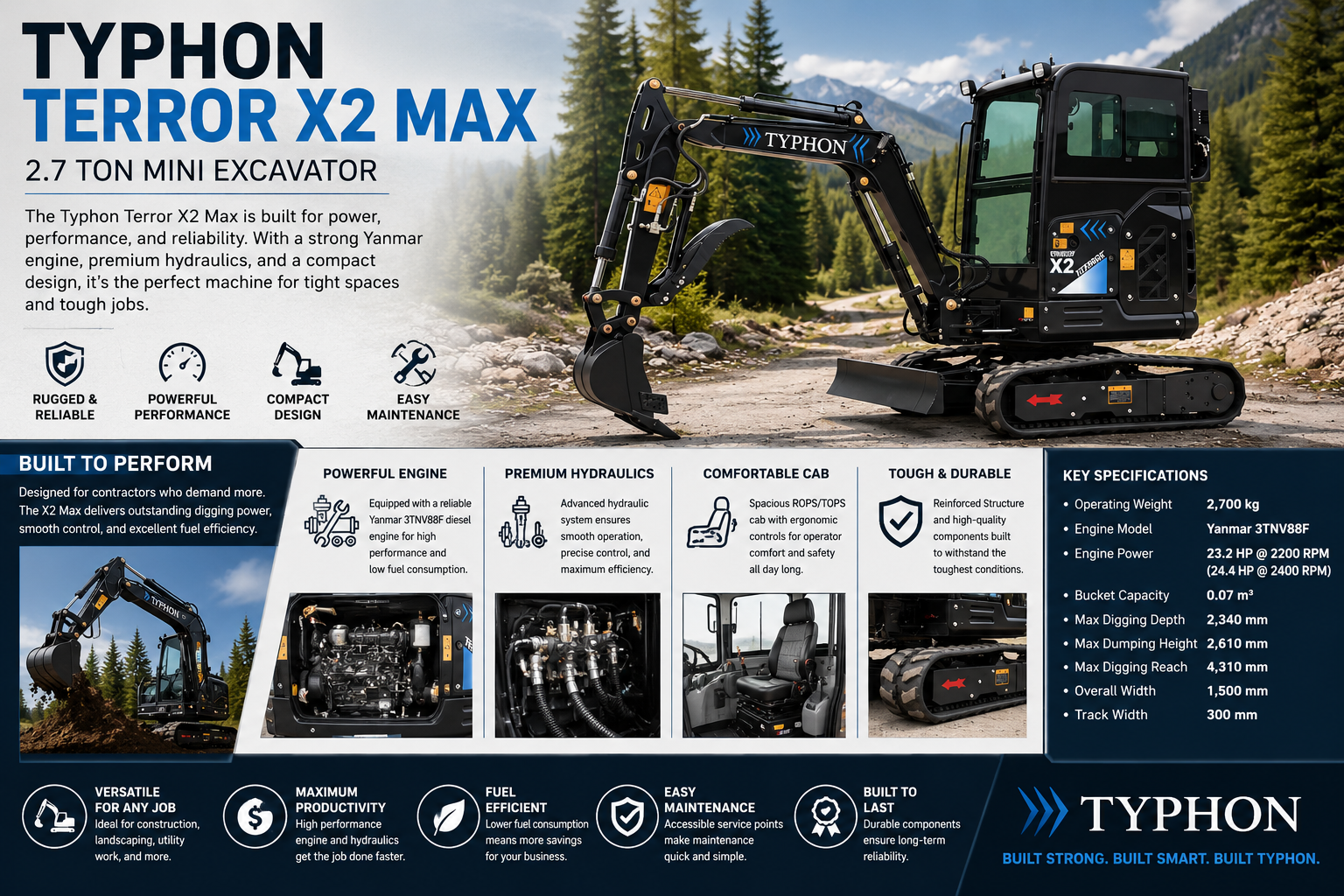
The TYPHON TERROR X2 MAX is becoming one of the standout compact excavators in 2026 thanks to its combination of power, hydraulic precision, and operator comfort.
Key specifications include:
- 2.7 ton operating weight
- Yanmar 3TNV88F diesel engine
- 23.2 HP output
- Pilot hydraulic controls
- Full hydraulic operation
- Compact body width
- Advanced boom swing capability
- Comfortable enclosed cabin
- LED lighting system
- Hydraulic thumb compatibility
The TERROR X2 MAX is designed for:
- Tight-space precision work
- Urban construction
- Landscaping
- Utility trenching
- Property development
- Farm projects
Its advanced hydraulic system provides smooth operation and excellent control, making it ideal for both experienced operators and growing businesses.
The machine’s compact dimensions also make transportation easier while maintaining strong digging capability.
🧠 The Future of AI Construction Equipment
The future of construction equipment will be shaped by intelligence, automation, and connectivity.
Over the next several years, excavators are expected to become even more advanced with:
- Fully autonomous digging systems
- AI jobsite coordination
- Predictive maintenance
- Self-learning hydraulic optimization
- Real-time obstacle mapping
- Smart attachment recognition
- Cloud-connected fleet ecosystems
Construction companies that adopt smart equipment early will likely gain major productivity advantages over competitors.
AI-powered excavators are no longer experimental concepts — they are becoming real-world productivity tools.
🔥 Biggest Smart Excavator Trends in 2026
1. Semi-Autonomous Digging
Machines assist operators with trench alignment and precision excavation.
2. AI Operator Assistance
AI helps reduce mistakes and improves productivity.
3. Smart Safety Systems
Collision prevention and human detection systems are expanding rapidly.
4. Connected Fleet Management
Contractors can remotely monitor excavator performance through cloud systems.
5. Electric Compact Equipment
Battery-powered excavators are growing rapidly in urban environments.
6. Remote-Control Construction
5G remote operation is expanding globally.
7. Intelligent Hydraulics
Modern systems optimize power automatically based on workload.
8. Multi-Function Compact Machines
Attachments allow mini excavators to perform many different tasks.